


Kodiak lands first commercial deal to supply driverless trucks for public highways
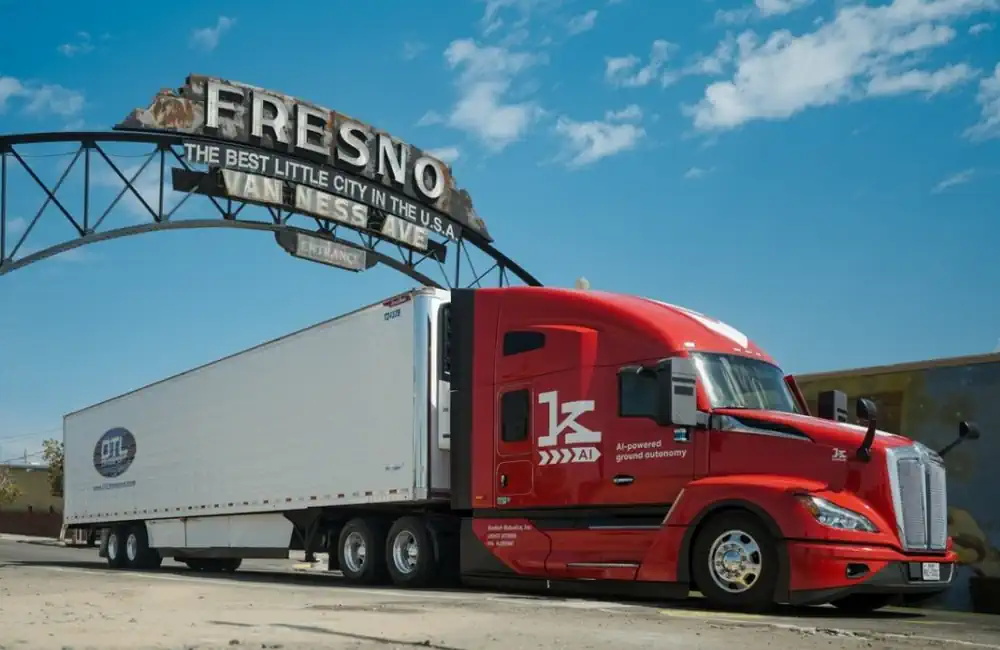
Kodiak AI will deliver 75 self-driving trucks to freight company DTL Transport starting in 2028. It’s the company’s first binding commercial deal for driverless big rigs that will run on public highways.
The contract, announced Wednesday, comes just ahead of Kodiak’s next big milestone: pulling human safety operators out of the cab to begin operating a driverless highway service in December. The company, which went public in September 2025, plans to launch that service by carrying goods for Ikea on Interstate 45 between Dallas and Houston.
DTL Transport, a California midmarket trucking company that hauls fresh produce and goods to grocery chains, plans to use the self-driving trucks on multiple interstate highway routes, starting with Dallas to El Paso, Texas, and Interstate 20 between Dallas and Atlanta. Kodiak has already conducted testing and operations on those two routes.
“One of the things that we love about midmarket carriers (like DTL) is that they are able to move with fast execution speed, much more at the speed of a startup or a small company or a tech company like Kodiak, and that they just want to get stuff done,” Kodiak founder and CEO Don Burnette told TechCrunch in an exclusive interview. “It’s easier for them to integrate into their fleet because they’re not as large, and we think that this is a real turning point for the self-driving industry in general.”
The contract should give Kodiak a revenue boost and a positive benchmark. Its shares have fallen 87% from their opening-day price. It also puts Kodiak on a path to become an “asset-light” technology supplier, meaning it would sell its technology rather than own and run trucks itself — a goal it shares with competitor Aurora Innovation.
Today, Kodiak has a number of customers under a trucking-as-a-service (TaaS) model, including Charger USA, Roehl Transport, and Werner Enterprises. Under this business model, Kodiak owns and operates the self-driving trucks as a third-party carrier on behalf of other companies. It currently carries freight for these companies on a few routes in Texas. Kodiak generates revenue carrying freight daily for these companies on three active routes, but Burnette described these operations as still being in pilot stage.
Ultimately, Kodiak wants to move to a driver-as-a-service (DaaS) model, in which customers own and operate the trucks. Kodiak licenses its technology, charging customers by the mile for the duration of the contract. DTL is Kodiak’s first on-highway DaaS customer, a relationship that was forged during a pilot program last month in California. In that pilot, Kodiak autonomously hauled perishable goods for DTL about 225 miles along Interstate 5 and California State Route 99 between Fresno, California, and Los Angeles, with a human safety operator behind the wheel.
“You have to prove out the technology first using your own truck, show them that it works, show them that it’s safe, show them that it integrates,” Burnette said, describing the TaaS model. “And then we want to be asset light. We don’t want to be in the business of running a trucking company.”
Atlas Energy Solutions has been a DaaS customer since 2024. Technically, Atlas was Kodiak’s first customer under a binding commercial contract, but its driverless trucks operate in off-road settings in West Texas’ remote Permian Basin. Atlas currently owns and operates 35 driverless trucks equipped with Kodiak’s self-driving system. Burnette said Kodiak is on track to have as many as 100 in service there by mid-2027.
Kodiak didn’t reveal the value of the deal with DTL Transport. However, its public 2025 investor presentation offers some clues about the contract’s potential value.
In that document, Kodiak forecast annual recurring revenue of $150,000 to $190,000 per truck. That forecast rests on several assumptions, including a per-mile licensing fee of about $0.97 (in line with current human driver costs per mile), annual mileage of about 225,000 miles a year per truck, and other factors.
Assuming those projections bear out, the deal with DTL Transport could generate at least about $11.2 million in annual recurring revenue once all 75 trucks are delivered.
Revisiting
AIBotTruck.com — The Freight Layer Just Got Its First Real Contract
Kodiak AI just signed its first binding commercial deal for driverless big rigs on public highways: 75 self-driving trucks for DTL Transport starting in 2028, on routes from Dallas to El Paso and Dallas to Atlanta. The timing matters — Kodiak plans to pull human safety operators out of the cab in December and run driverless freight for Ikea on Interstate 45 between Dallas and Houston. And the economics are now legible: at a forecast $0.97 per mile, roughly 225,000 miles a year per truck, and $150,000–$190,000 in annual recurring revenue per truck, the DTL deal could be worth at least about $11.2 million in ARR once all 75 trucks are delivered. Kodiak’s shares are down 87% from their opening-day price, so this contract is as much a proof point as a revenue line.
When we first picked AIBotTruck.com alongside the Tesla Semi story, the bet was on a vision: electric plus autonomous freight. That was a thesis without a contract. This week the thesis got a binding signature, a named customer, a route map, and a per-mile price. The category has moved from “will this happen” to “who supplies the trucks and who owns the fleet” — and Kodiak’s own TaaS-to-DaaS pivot (selling technology by the mile rather than running trucks itself, the same asset-light goal Aurora Innovation shares) is the clearest sign yet that the freight layer is becoming a real business layer. That is exactly the moment a category name earns a revisit.
AIBotTruck.com still holds up structurally. Three tokens, each doing real work: “AI” signals the autonomy stack, “Bot” captures the driverless, operator-free character of the vehicle, and “Truck” is the precise asset class — not “freight,” not “logistics,” not “carrier,” but the physical truck that the contract is actually about. It reads at a glance, spells itself, and does not lean on a portmanteau. For a name tracking the driverless trucking race, the word “Truck” has aged well: this article is not about platforms or software layers, it is about 75 trucks on Interstate 20.
The honest limitation is the same one we flagged the first time: “Bot” carries a slightly toy-like connotation that undersells the industrial weight of Class 8 freight, and the name is a category descriptor rather than a brand — it will never be the name of Kodiak itself, Aurora, or DTL. It remains a practical alternative for a category media property, a fleet-tech directory, or a tracking site, not an exact-match brand for any single operator. Readers should also note that this is a revisit, not a fresh pick: the domain’s value story is continuity, not novelty.
The long-term bet has strengthened, not changed. Last time it was a bet that autonomous freight would become real; this time there is a contract, a December driverless launch, an Ikea route, and a per-mile licensing model to point at. The freight layer will take years to scale — 75 trucks starting in 2028 is a rounding error against the millions of Class 8 trucks on US highways — but the direction is now signed rather than speculated. A domain that owns the “AI bot truck” phrase is a bet on that multi-year build-out, not a short-term flip on one contract announcement.
Disclosure: This is an editorial domain recommendation, not investment advice. Domain values fluctuate with industry sentiment.
Source:https://techcrunch.com/2026/10/28/kodiak-lands-first-commercial-deal-to-supply-driverless-trucks-for-public-highways/