


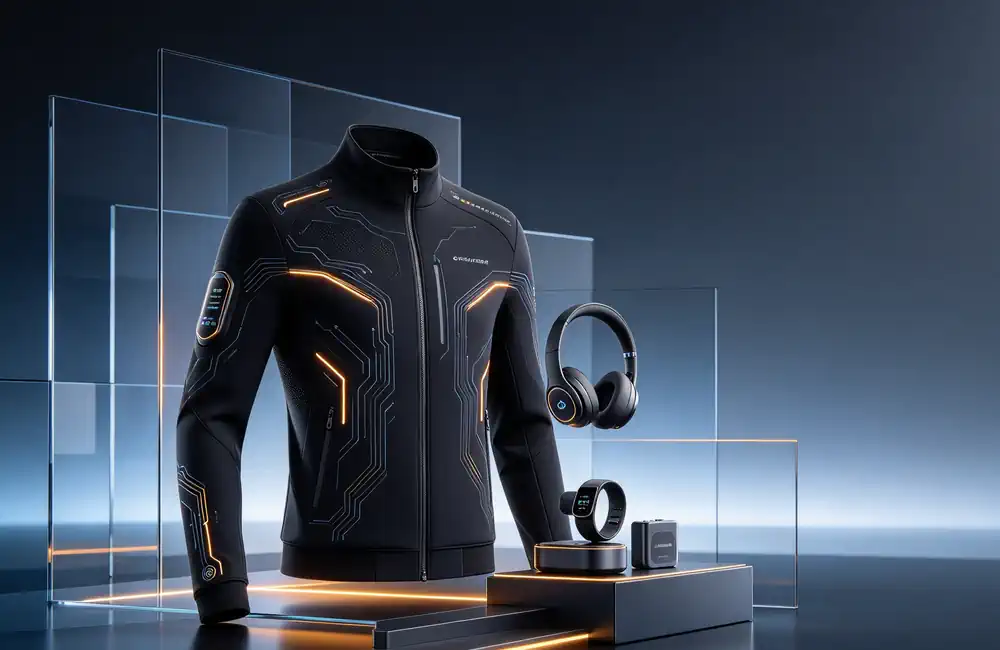
The hottest AI wearables and gadgets you should know about
A slew of AI-powered gadgets on the market aims to integrate artificial intelligence into our daily lives like never before.
Some of these AI wearables — including necklaces, rings, and wristbands, as well as portable devices — serve as productivity tools, while others claim to act as friendly companions listening to your everyday thoughts. Even OpenAI is working on a compact AI companion device.
Below, we’ve rounded up some of the most notable devices.
Bee is an affordable pendant priced at $49.99 that can either be clipped to your clothing or worn like a fitness band. This device records everything it hears and learns your routines and preferences to create reminders and notes for you. It even features a mute button for those times you want some privacy.
The companion app (currently available only on iOS) is included with a $19 monthly subscription. The app allows you to interact with Bee directly and ask it questions. You can also get key takeaways from your day and chronological transcripts of your conversations.
Amazon acquired the wearables startup in July 2025, launching its first new products earlier this month.
Amazon introduced two new devices: the Bee Frontier, priced at $74.99, which can be worn on the wrist or clipped to clothing, and the Bee Eclipse, priced at $99.99, a credit-card-sized device that attaches magnetically to the back of a smartphone.
Both offer the same core functionality as the previous generation, positioning Bee as a more affordable alternative to AI devices such as the Plaud Note and Plaud NotePin. Users can also choose to connect Bee to Alexa.
Friend is one of the most hyped entrants in the “personal AI” device market.
This $129 white pendant hangs around your neck and functions as an emotional support companion. It recognizes your tone and mood, allowing you to chat with it as if it were a friend. It connects to your phone via Bluetooth and constantly listens, ready to respond or send you proactive messages, like wishing you good luck before an interview.
However, it has also faced criticism, including backlash against its subway ad campaign in NYC. People vandalized the ads, writing messages like “surveillance capitalism.”
Likely as an attempt to stay relevant, the company recently unveiled a major product update, introducing a new voice feature. Under the name “Friend 2.0,” the updated device includes a built-in speaker that allows it to communicate with users and express a more distinctive personality.
Formerly known as Rewind, Limitless is another conversation-recording pendant priced at $99.
This device continuously listens, transcribing meetings, calls, and conversations (with consent) into searchable and summarized knowledge. It’s ideal for professionals, especially journalists, looking to recall important discussions.
The companion app comes with 10 hours of AI features per month — such as transcription and summaries — with the option to unlock unlimited features for $29 per month.
Meta introduced its first AI wearable in September, offering a new way for users to access its personal AI assistant, Muse.
The device has not yet shipped, but it is expected to feature Jolly, a playful digital avatar that represents the AI assistant. Housed in a pocket-sized device that can be carried around or attached to a keychain, the wearable includes a miniature display showing the avatar. Users will be able to interact with Muse through voice commands and have it complete tasks for them.
Nirva is a startup founded by former Meta Reality Labs employees, building an AI wearable focused on personal growth rather than productivity or meeting notes.
Worn as a pendant or bracelet, the device listens to the wearer’s speech and uses AI to turn everyday experiences into a personal journal, helping users better understand their emotions, communication style, and habits. Through its companion app, users can explore patterns in their behavior, gain insights into how they communicate, and find ways to improve.
Nirva plans to open orders in November, with shipments to early users targeted for the end of the year. The device will cost $249.
Priced at $89, this device can answer your questions, summarize your conversations, create to-do lists, and help schedule meetings. Additionally, Omi is constantly listening and running your conversations through ChatGPT, allowing it to remember the context about you and offer personalized advice.
Omi can be worn as a necklace, but another notable aspect is that it can be attached to the side of your head with medical tape and can detect when you’re speaking to it.
At $159, Plaud’s NotePin is one of the pricier options on this list; however, its built-in AI transcription and summarization features make it a valuable tool for lawyers, journalists, and students attending meetings or lectures.
The tiny wearable voice recorder can be worn on your wrist or attached magnetically to your clothing. The recordings are saved in real time on your phone, eliminating the hassle of manual note-taking. The device includes 300 free monthly transcription minutes, but with the $8.33 per month Pro plan, you upgrade your transcription time to 1,200 minutes.
This year, the company is gearing up to launch a $179 ultra-thin note-taking device called the Plaud Note Pro , which is now available for preorder.
Rabbit R1 is another AI gadget that has quickly become a topic of interest in the tech world, despite facing some challenges during its initial launch. This small, retro-styled handheld device features a touchscreen and rotating camera, at a price point of $199.
The device is designed to be phone-adjacent, allowing you to perform tasks such as booking flights, ordering meals, and controlling apps without needing to pull out your phone each time. Following a crucial software update that rectified previous performance issues, the Rabbit R1 now boasts expanded AI features. For instance, it introduces “Creations,” a feature that allows you to build your own tools and even games.
Sandbar emerged from stealth last year, unveiling the Stream ring, an AI wearable designed for note-taking.
It features a built-in microphone that remains off by default and can be activated through a flat, touch-sensitive surface on the top of the ring. By pressing and holding the panel, users can record notes, interact with an AI assistant through the companion smartphone app, and manage media playback, including playing, pausing, skipping tracks, and adjusting volume
includes a built-in microphone that stays disabled by default and can be switched on via a touch-sensitive panel on the ring’s upper surface. Users can press and hold it to capture notes, communicate with an AI assistant through the companion mobile app, and control music.
The Stream ring is expected to launch this summer at $299, with silver and gold finishes available.
With more than a dozen devices now spanning $49 to $299, choosing one has become its own problem — which is exactly the gap a shopping layer is meant to fill.
Domain Pick:
AIWearShop.com — A Commerce-Layer Entry Point to the AI Wearables Boom
TechCrunch’s roundup lands at a moment when the AI wearable category has quietly matured from novelty to a crowded shelf: Bee at $49.99 (now owned by Amazon, which just shipped the $74.99 Bee Frontier and $99.99 Bee Eclipse), Friend at $129 pushing a “Friend 2.0” update after its NYC ad backlash, Limitless at $99, Meta’s Muse wearable, Nirva at $249, Omi at $89, Plaud’s NotePin at $159 with a $179 Note Pro on preorder, Rabbit R1 at $199, and Sandbar’s Stream ring arriving this summer at $299. That is a dozen products, six price tiers, and at least four distinct use cases — note-taking, companionship, productivity, and personal growth — all competing for the same wrist, neck, and pocket.
When a category fragments this fast, the value migrates from any single device to the layer that helps buyers navigate the shelf. The AI wearable market is now in that phase: consumers do not need another pendant, they need a place to compare pendants. That is the timing logic behind a commerce-front domain — the moment a category has enough SKUs to confuse a buyer, a shopping-layer name becomes useful.
AIWearShop.com reads cleanly as three familiar tokens: AI, Wear, Shop. “Wear” is the precise category word — it covers pendants, rings, wristbands, and clip-on devices without committing to any one form factor, which matches a roundup that spans all of them. “Shop” is the differentiator: it signals transaction and curation rather than editorial or product branding, which is exactly the gap in a market where every device has its own site but no neutral storefront does. The name is legible at a glance, spells itself, and does not depend on a clever portmanteau that a buyer has to decode.
The honest limitation is the word “Shop” itself. It caps the domain’s ceiling: this is not a brandable name for a device company, a media property, or a SaaS product — it is a commerce and curation name, best suited to an affiliate storefront, a comparison marketplace, or a category guide that monetizes through links. Readers should treat it as a practical alternative for the shopping layer, not an exact-match claim on the category. Anyone pitching it as a “brandable entry point” would be overselling it.
The long-term bet is on the shelf, not the pendant. AI wearables will consolidate — some of the twelve names above will not survive the next two product cycles — but the buyer’s need to compare, read reviews, and choose will persist and likely grow as prices spread from $49 to $299. A domain that owns the “AI wear shop” phrase is a bet on that durable middle layer, not a short-term flip on any single device’s hype. It is the kind of name that becomes more valuable as the category gets more confusing, which is the opposite of a momentum trade.
Disclosure: This is an editorial domain recommendation, not investment advice. Domain values fluctuate with industry sentiment.
Source:https://techcrunch.com/2026/10/25/the-hottest-ai-wearables-and-gadgets-you-should-know-about/