


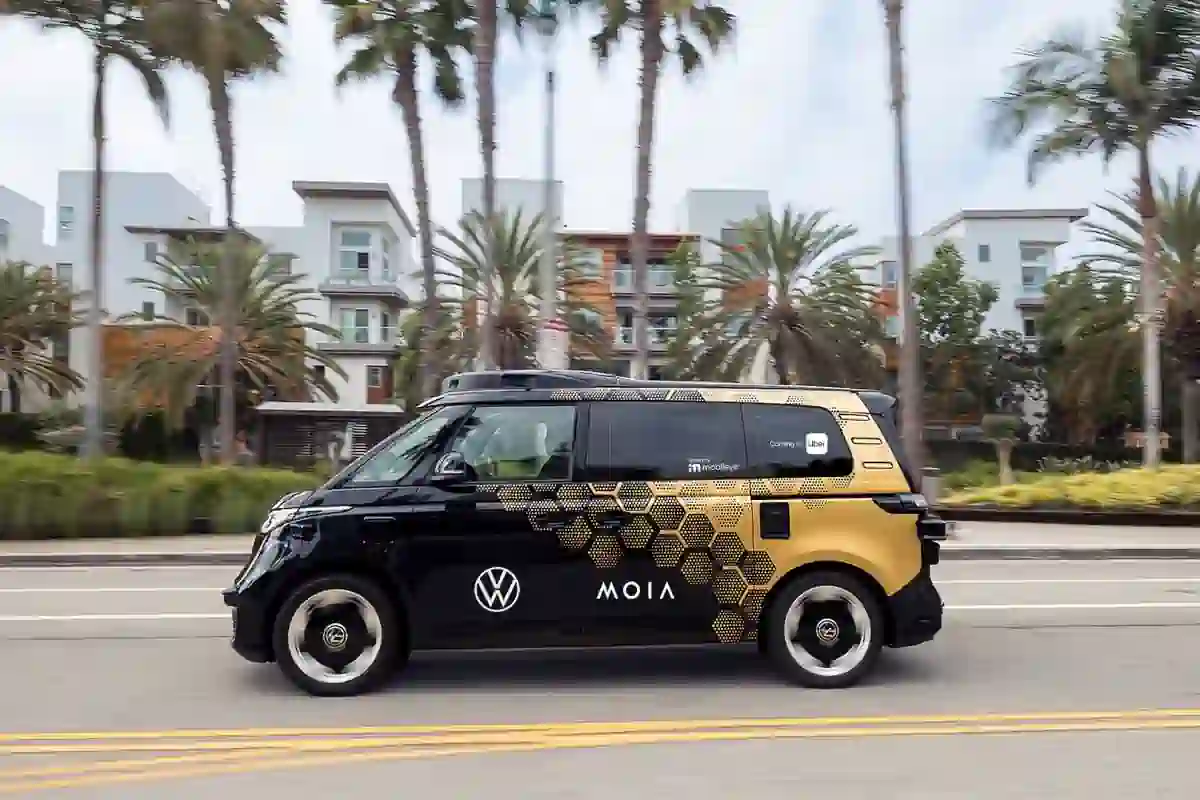
Volkswagen begins testing its self-driving microbuses in Los Angeles ahead of launch with Uber
Volkswagen subsidiary MOIA America and Uber have started testing autonomous microbuses in Los Angeles, the companies announced Wednesday, the latest step as they prepare to launch a robotaxi service by late 2026.
A year ago, MOIA America and Uber unveiled an ambitious plan to launch a commercial robotaxi service — using autonomous versions of Volkswagen’s electric ID. Buzz minivan — in multiple U.S. cities over the next decade. Los Angeles is the first city on that list.
Testing will start in the next few weeks with about 10 autonomous ID. Buzz vehicles in Los Angeles, according to the company. The production version of the driverless vehicle seats four people.
Paul DeLong, president of commercialization at MOIA America, called Los Angeles a natural market to introduce the company’s autonomous vehicles for ride experiences, “given its long history of shaping car culture and embracing new mobility technologies.”
Since last year’s announcement, MOIA America and Uber set up a joint facility in Los Angeles for day-to-day fleet operations. The test fleet is small for now, but Volkswagen says it will eventually scale to more than 100 autonomous ID. Buzz vehicles. The vehicles will initially launch with a human safety operator on board. Driverless operations are expected to begin in 2027, the company said.
Sascha Meyer, the chief commercial officer for Volkswagen Autonomous Mobility, said this next step reflects the “strong momentum behind the strategy to bring autonomous mobility into real-world operation.”
💡 The “Two Paths” of Autonomous Mobility
The Volkswagen (MOIA) and Uber partnership announcement is a watershed moment. It validates not just one, but two distinct blueprints for the Robotaxi economy: the ID. Buzz Microbus for shared group rides, and the Robotaxi for individual point-to-point travel.
As the article highlights, Uber is navigating a “hybrid world” of regulations and partnerships. In this landscape, the distinction between a “Bus” and a “Taxi” becomes crucial. The “Bus” represents efficiency and pooling (perfect for the ID. Buzz), while the “Taxi” represents autonomy and on-demand luxury.
This news proves that the market is bifurcating. The domains below represent the definitive branding for these two specific categories as they move from testing to commercial launch by late 2026.
The MOIA America name is relatively new branding for Volkswagen’s autonomous vehicle projects in the U.S., known as Volkswagen ADMT until early 2026. But the MOIA brand has been around for a while, since it was first launched by Volkswagen in 2018 at TechCrunch Disrupt London, and is best known in Europe, where it operates a ride-pooling service and tests autonomous vehicle tech in Hamburg, Berlin, Munich, and Oslo. The name change is supposed to reflect the connection between the U.S. and Europe entities.
MOIA America still must navigate a long regulatory process before it can deploy a commercial robotaxi service — meaning driverless vehicles that charge humans for rides — in California. The company will need permits from the California Department of Motor Vehicles, which regulates autonomous vehicle testing and deployment in the state. It will also need a ride-hailing permit from the California Public Utilities Commission.
Uber, meanwhile, has spread out its bets on autonomous vehicles. The company has partnerships with 25 companies that are applying autonomous vehicle technology to delivery, drones, ride-hailing, and trucking. In the U.S., its most visible partnership is with Waymo. But the company has taken its AV ambitions to other markets, locking in agreements with Chinese companies to launch robotaxis in Europe and the Middle East, as well as startups like U.K.-based Wayve.
Uber recently made a deal with Rivian to buy 10,000 fully autonomous R2 robotaxis ahead of a planned rollout in San Francisco and Miami in 2028. Under the agreement, Uber is making an initial $300 million investment in Rivian.
Recommended related domains:
1.AIBotbus.com
- The “Microbus” Connection: The article explicitly mentions the testing of the Volkswagen ID. Buzz microbus. This vehicle is not designed for solo rides; it is engineered for ride-pooling and group mobility. The term “Bus” in this context doesn’t imply a clunky city bus, but rather a smart, agile “Mobility-as-a-Service” (MaaS) vehicle.
- Why this domain?
AIBotbus.comis the perfect linguistic match for the ID. Buzz strategy. It captures the essence of an AI-driven collective transport system. As MOIA and Uber scale to 100+ vehicles in Los Angeles, they are essentially launching an “AI Bus” network. This domain is the ultimate asset for the “shared mobility” segment of the Robotaxi market, where efficiency and capacity (4 seats in the ID. Buzz) are key. It is the category-defining name for the future of intelligent public transit and pooled rides.
- The “Taxi” Imperative: While Volkswagen focuses on the Buzz, Uber’s core business remains the individual ride-hail. The article notes that Uber has “spread out its bets” and is the platform aggregator. For the single-passenger or family-only Robotaxi experience, the “Taxi” nomenclature is king.
- Why this domain?
AIBotaxi.comrepresents the pinnacle of the consumer-facing Robotaxi market. It combines the familiarity of the “Taxi” with the futuristic “AI Bot.” In the context of the article, where Uber is navigating complex regulations and partnerships (including with Rivian and WeRide), this domain serves as the universal standard for the “driverless cab” experience. It is short, punchy, and instantly communicates the concept of an autonomous vehicle available for hire, making it the ideal brand for the premium, on-demand segment of Uber’s autonomous future.
As MOIA America scales its fleet and Uber integrates these services into its app, the digital real estate for
AIBotbus.com and AIBotaxi.com becomes incredibly valuable. These domains are not just speculative assets; they are the logical, descriptive names for the two distinct pillars of the upcoming autonomous mobility revolution.Source:https://techcrunch.com/2026/04/08/volkswagen-moia-uber-los-angeles-testing-self-driving-microbuses-id-buzz/
I am glad to be a visitant of this perfect site! , thankyou for this rare information! .
Thank you a lot for sharing this with all of us you really recognise what you’re speaking about! Bookmarked. Kindly additionally consult with my site =). We could have a hyperlink change contract among us!