


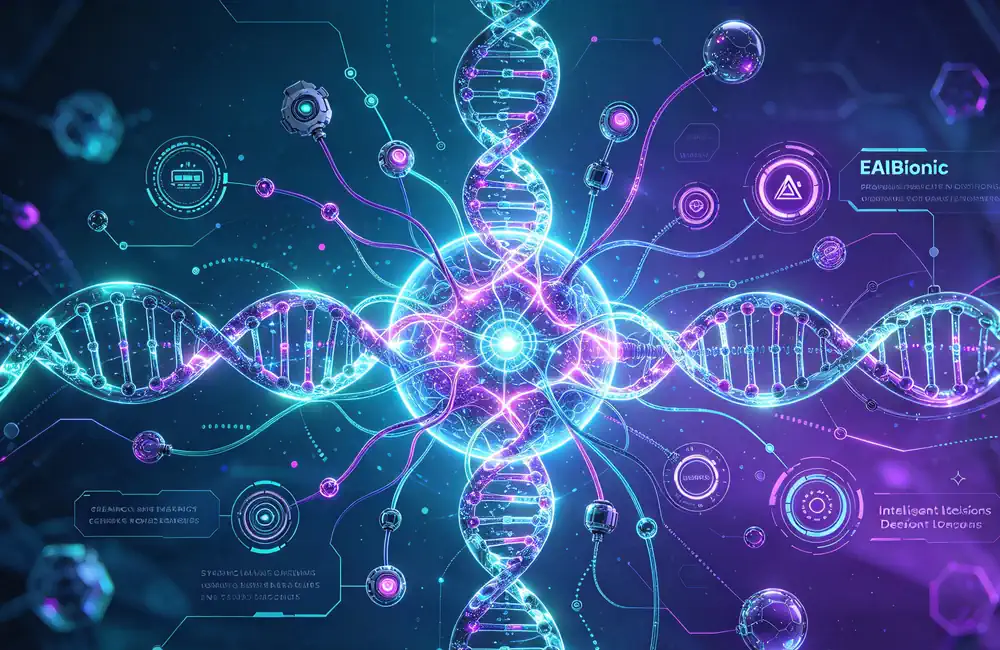
EAIBionic: Naming the Extension of Bion
By VCShot Brand Stories | Senior Editor
There is a distinction in the vocabulary of embodied intelligence that is rarely made explicit. It is the difference between the unit and the extension—between a single functional entity and the system it becomes when it is deployed, combined, and scaled.
EAIBionic, a name that recently crossed this editor’s desk, is an attempt to claim that distinction. It does not describe a bionics company. It does not claim a bio-inspired methodology. It names the extension—the moment when the functional unit becomes a system, and the system becomes a species.
And in doing so, it raises a question that the industry has been too focused on the unit to ask: What happens after the unit is defined?
The Bion and the Bionic
There is a word that has been hiding in plain sight for two thousand years. It is the root of “bionic” and “bionics,” but it is not a derivative of them. It is their origin.
The word is Bion. In ancient Greek, it derives from bios (βίος)—”life.” In modern biology, a bion is defined as “a physiological individual, characterized by functional distinctness and independence, as distinguished from the morphological individual.” A Bion is not defined by its form. It is defined by its function.
From Bion, the chain extends: Bion → Bionic (possessing the qualities of a Bion) → Bionics (the study of emulating biological systems). Bionic is the branch. Bion is the seed.
Most technology brands operate at the level of the branch. They build bionic things. They imitate forms. They pursue what the ancient Greeks called Morphe—form, shape, the principle of essence as distinguished from hyle, the material substrate.
EAIBionic operates at the level of the extension. It asks: What happens when the functional unit is not just defined but deployed? When the Bion is not just a concept but a system?
The answer is EAIBionic.
From Unit to System
A Bion, by definition, is functionally distinct and independent. It is a unit—a minimal, self-contained entity with a clear boundary of responsibility.
But a single unit is not a species. For intelligence to scale—for it to inhabit the physical world, to manipulate objects, to navigate environments, to collaborate with other agents—units must combine into systems. And systems must evolve into something larger.
This is the territory of EAIBionic. It is not the study of individual units. It is the study of how units become systems, and how systems become species.
Consider the analogy from biology. A single cell is a Bion. But a multicellular organism is not just a collection of cells. It is an emergent system with properties that no single cell possesses. The whole is not the sum of its parts. The whole is something new.
EAIBionic claims this emergent space for embodied intelligence. It is the moment when individual functional units—each one a Bion—combine into systems that can perceive, decide, and act as a coherent whole. And when those systems, in turn, evolve into something that resembles a species.
The Etymology of Bionic
The word “bionic” was coined in 1958 by Jack E. Steele, an engineer at the Wright-Patterson Air Force Base. He combined the Greek root Bion with the suffix *-ic* (having the nature of). The result was a word that meant “having the nature of a Bion”—possessing the qualities of a functionally distinct, independently operable life unit.
But the word was quickly appropriated by science fiction and popular culture. “The Six Million Dollar Man” gave us bionic limbs. “Bionic” became synonymous with “superhuman” and “technologically enhanced.” The original meaning—the functional unit—was lost.
EAIBionic restores that meaning. It does not use “bionic” as a synonym for “enhanced.” It uses it in its original sense: the extension of the Bion into systems and species.
When a unit becomes a system, and a system becomes a species, that is not an enhancement. That is an evolution. That is EAIBionic.
What EAIBionic Is Not
Let us be equally clear about what EAIBionic refuses to be.
We are not a bionics company. Bionics is the study of emulating biological systems. It is a noble pursuit, but it is not ours. We do not emulate. We extend.
We are not a bio-inspired robotics company. Bio-inspiration is a design methodology. It looks to nature for patterns. We look to nature for origins. But our goal is not to copy nature. It is to extend it.
We are not a “bionic augmentation” company. Augmentation implies adding something to a human. We are not interested in adding. We are interested in evolving—in the emergence of new forms of intelligence that are not merely enhanced versions of existing ones.
If embodied intelligence has a stack, we are not a layer in it. We are the moment when the stack becomes a species.
The Bion Family
EAIBionic does not stand alone. It is part of a family of names that share a common root and a common purpose.
-
AgentBion claims the threshold between tool and actor—the moment when an agent becomes a species.
-
SiBions claims the minimal unit of silicon-based intelligence—the building block of the Bion family.
-
SiliconBion claims the substrate itself—the silicon from which the foundation is built.
-
EAIBion claims the ontology of the perceiving subject—the functional unit that perceives.
-
EAIBionic claims the extension—the moment when units become systems, and systems become species.
Together, they form a complete narrative: from substrate to foundation, from unit to species, from species to extension. This is not a collection of domains. It is a family of concepts.
That family is EAIBionic.
Four Dimensions of Brand Architecture
From this editor’s perspective, EAIBionic succeeds on four dimensions that deserve examination.
Etymological Precision. The choice of Bionic over “bio-inspired” or “biomimetic” is deliberate. It is the extension of Bion, not a synonym for “enhanced.” The word carries a precise etymology that most of its users have forgotten.
Systemic Logic. The name identifies a specific gap in the embodied AI landscape—the lack of a category for “the extension of the functional unit into a system”—and claims it with precision.
Family Coherence. The name is part of the Bion family, which includes AgentBion, SiBions, SiliconBion, and EAIBion. This is not a collection of unrelated domains. It is a conceptual ecosystem.
Narrative Bandwidth. The name supports a long arc from “the extension of the unit” to “the emergence of a new species” without requiring a rebrand.
Editor’s Observation: The Sixth Step in the EAI Line
Among the brands this column has featured, EAIBionic is the sixth under the EAI prefix. The progression has moved beyond the core loop and into the architecture of extension.
-
EAISee named the first instant of perception—before understanding, there was light.
-
EAISens named the metalanguage of perception—the undivided unity of sensing and understanding.
-
EAIBion named the ontology of the perceiving subject—the functional unit that perceives.
-
EAIThink named the cognitive threshold of the perceiving subject—the moment when perception becomes intention.
-
EAIMove named the closure of the loop—the moment when intention becomes motion, and motion becomes proof.
-
EAIBionic names the extension of the unit—the moment when a Bion becomes a system, and a system becomes a species.
From the act of perception (See), to the language of perception (Sens), to the existence of the perceiver (Bion), to the cognition of the perceiver (Think), to the action of the perceiver (Move), to the extension of the perceiver (Bionic)—the line extends beyond the individual agent and into the architecture of systems and species.
EAIBionic is not a sixth filler under EAI. It is the point where the series shifts from asking what the agent is to asking what the agent becomes when it is no longer alone.
A Closing Observation
The most durable brands are those that understand themselves as carriers of meaning rather than purveyors of products. They name themselves after concepts worth recovering, extensions worth making, species worth becoming.
EAIBionic has chosen its name with evident care. It reaches back to the Greek root Bion—the functionally distinct unit of life—and claims its extension for the architecture of embodied intelligence. And it pairs that claim with the defining acronym of the current AI era: EAI.
The brand’s declaration captures this ambition: “Bion defines the unit. Bionic defines the extension. EAIBionic is the space between.”
Whether that ambition is realized remains to be seen. But in a world where AI brands are too often named for what they do rather than what they extend, the ambition to name an extension—the moment when a unit becomes a species—deserves recognition.
Editor’s Note: This article is part of VCShot’s Brand Stories column. It is independent editorial content and does not constitute investment advice. VCShot may hold commercial interests in the assets mentioned in this article. For domain acquisition inquiries related to brands featured in this column, visit EAIBionic.com.