


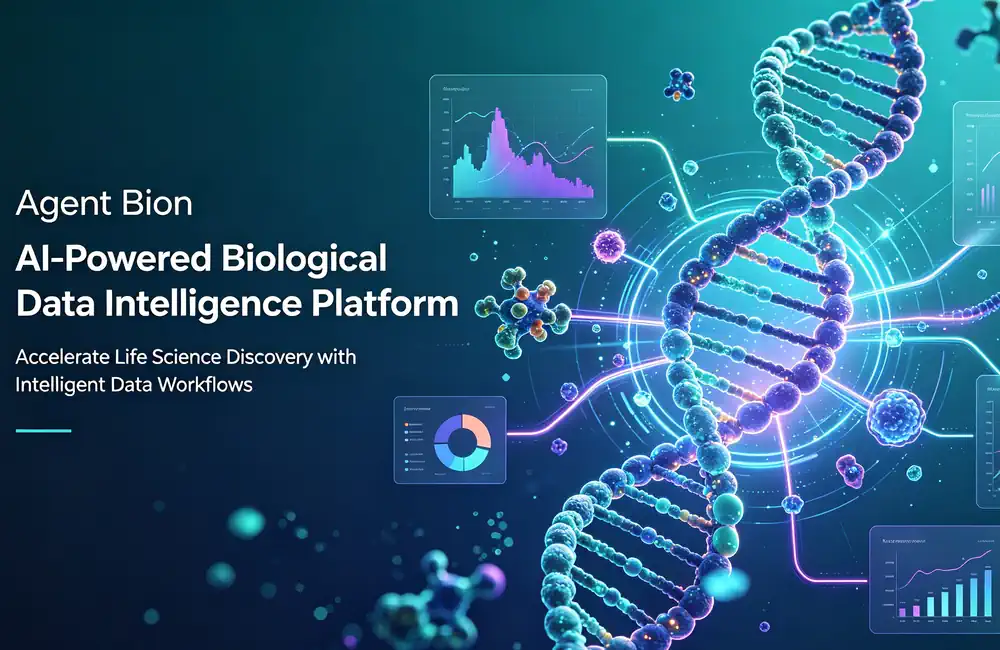
AgentBion:Naming the Speciation of Digital Agency
By VCShot Brand Stories | Senior Editor
In the history of brand naming, some names describe what a company does. Others claim a category. A rare few—the ones that endure—name a moment of transformation.
AgentBion, a name that recently came across this editor’s desk, belongs to that final category. It does not describe a product. It does not claim a market. It names a threshold: the moment when an intelligent agent ceases to be a passive executor and becomes an autonomous actor, capable of perceiving, deciding, acting, and adapting.
This is brand naming as philosophical declaration. And in the crowded, noisy landscape of AI Agent branding, that distinction matters.
The Problem with “Agent”
Between 2025 and 2026, the AI Agent sector has experienced an explosion. Global market capitalization surpassed the $100 billion mark, with enterprise-grade deployments growing over 300% year-over-year. Tens of thousands of teams are building systems that can “act autonomously.”
Yet amid this frenzy, a fundamental question has been overlooked: What do we call this emerging new species?
The current vocabulary falls short. “Bot” carries the legacy of chatbots—reactive, transactional, limited. “Assistant” implies support rather than leadership. “Agentic System” is an academic adjective, a description of a property rather than an identity.
None of these terms capture what is most profound about AI Agents: they are no longer passive tools. They are active actors. They no longer wait for instructions. They make decisions. They do not remain static. They evolve through environmental interaction.
An entity with agency deserves a name that belongs to the order of subjects, not objects. This is the naming problem that AgentBion addresses—not by following the trend, but by defining the species.
The Architecture of the Name
AgentBion is a two-part construction, and each part does distinct strategic work.
The Anchor: “Agent”
The first half of the name performs the essential function of sector identification. In today’s AI landscape, no single word anchors the sector more precisely than Agent. It is the shared core terminology of leading AI laboratories—OpenAI, DeepMind, Anthropic. It is the keyword that industry analysts have identified as the defining theme of the coming decade. It is the most popular project tag on developer platforms.
Choosing Agent as the first half of the brand name means the brand is automatically categorized into the AI Agent sector—the most active, most certain, and most imaginative sector in technology today. No explanation required. No education needed. This is the primacy effect in brand naming: the first word determines mental categorization.
The Core: “Bion”
The second half of the name—Bion—is where the strategic depth resides.
Bion is not a coined suffix. It is a Greek root (βίον) with a precise scientific definition: “an individual physiological unit characterized by functional distinctness and independence.” This definition contains two elements that map with remarkable precision onto autonomous AI Agents: functional distinctness (a clear boundary of responsibility, not a vague existence) and functional independence (an independently operable unit, not an appendage of a larger system).
In microscopic biology, Bion carries an even deeper meaning: it describes transitional forms at the threshold between non-living matter and living matter. Bions are not fully on either side. They occupy the threshold—a dynamic state of becoming, rather than a static state of being.
When mapped onto AI Agents, the isomorphism is striking. AI Agents stand at the threshold between code-based tools and digital entities with agency. They are no longer purely non-living—conventional software—nor have they fully reached the status of living organisms. They are crossing that boundary.
This is what makes Bion the precise choice. It is not a borrowing from “bionics” or a modification of “bionic.” It is the etymological core—the origin of the semantic chain. Choosing Bion means standing at the source: more fundamental than Bionic, more essential than Bionics.
The Convergence
When Agent and Bion converge, the result is not simple concatenation but a singular naming event. Agent represents silicon-based intelligence—computation, logic, decision, action. Bion represents the quality of agency and becoming—adaptation, evolution, subjectivity, operational independence.
AgentBion names the emergent outcome: silicon-based intelligence acquiring the quality of agency.
This is not a juxtaposition. It is a fusion. Just as YouTube (You + Tube) created the concept of “your television,” AgentBion creates the concept of “an intelligent agent with agency as its defining quality.” It is a complete, indivisible proposition: an agent is not only intelligent—it possesses the quality of agency that defines its operation and evolution.
The Four Dimensions of Irreplaceability
An irreplaceable brand name must withstand scrutiny across multiple authoritative dimensions. AgentBion demonstrates unique strength across four.
Sector Definition. Opening with Agent ensures global recognition at zero cognitive cost. The brand is automatically positioned within the AI Agent sector—without explanation. Alternatives like “Bot” are too narrow, “Assistant” is outdated, and “Agentic” is an adjective lacking entity status.
Brand Exclusivity. Bion is a coined root with the highest level of distinctiveness in major trademark systems. As a root without generic meaning in English, it provides inherent legal exclusivity—not “exclusive after registration,” but “exclusive from inception.” Generic-word combinations face higher rejection rates. Coined-root combinations enjoy exceptionally high registration success.
Etymological Authenticity. Among all roots related to agency and life, Bion is the only one that simultaneously satisfies scientific precision, a dynamic threshold framework, and etymological core status. Its scientific definition—”functionally distinct, independently operable unit”—creates a precise correspondence with the essence of AI Agents.
Market Scarcity. In the current global domain market, .com domains beginning with Agent are extremely scarce. Those beginning with Agent and carrying semantic depth are nearly extinct. Those combining Agent, semantic depth, and brand exclusivity are among the rarest assets available. AgentBion.com belongs to this final category.
What This Means for Brand Architects
AgentBion offers a lesson in strategic naming that extends beyond the AI sector.
Anchor in the Present, Elevate with the Eternal. The name succeeds because it pairs a contemporary technical keyword—Agent—with a concept of ancient, strategic depth—Bion. The first half ensures instant recognition. The second half ensures enduring differentiation.
Name a Threshold, Not a Product. Products have lifecycles. Thresholds define eras. AgentBion does not sell a tool; it names a moment of transformation—the moment when intelligent agents acquire agency. That is a positioning that can outlast any particular product roadmap.
Choose Roots Over Neologisms. In an era obsessed with inventing new words through creative spelling, there is power in reaching for roots that already carry meaning. Bion is not a new word. It is a discovered word—a concept that has endured for over 2,500 years and now finds precise application in a new domain.
A Closing Observation
The most durable brands are those that understand themselves as carriers of meaning rather than purveyors of products. They name themselves after ideas worth preserving, concepts worth developing, thresholds worth crossing.
AgentBion has chosen its name with evident care. It reaches back across millennia to claim a concept—Bion—that speaks to the threshold between non-living and living, between tool and actor, between code and creature.
In the autonomous AI Agent space, no other name simultaneously satisfies the five criteria that matter most: instant recognition, global exclusivity, scientific precision, philosophical depth, and legal exclusivity.
Whether the brand lives up to its name remains to be seen. But in a world where AI Agents are too often named for what they do rather than what they are becoming, the ambition to name a species deserves recognition—and perhaps emulation.
“They build agents. We define agency.”
That is not a tagline. It is a naming philosophy.
Editor’s Note: This article is part of VCShot’s Brand Stories column. It is independent editorial content and does not constitute investment advice. VCShot may hold commercial interests in the assets mentioned in this article. For domain acquisition inquiries related to brands featured in this column, visit AgentBion.com.