


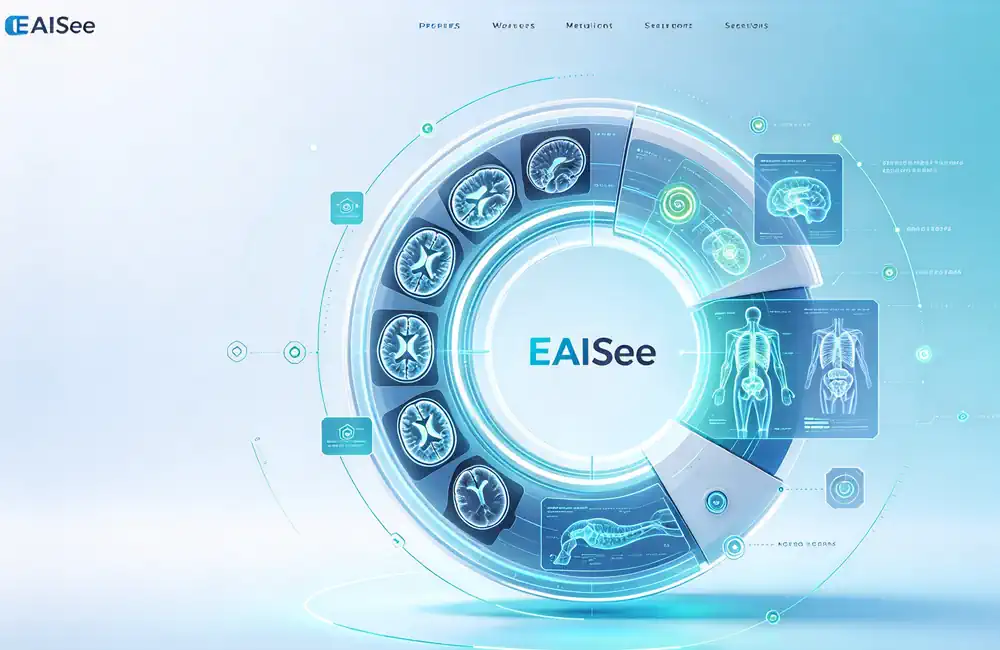
EAISee: Naming the Zero Layer of Embodied Perception
By VCShot Brand Stories | Senior Editor
There is a moment in the evolution of any technology when the vocabulary stops working. The old words still describe what the technology was. They cannot describe what it is becoming. That moment has arrived in the world of embodied AI.
EAISee, a name that recently crossed this editor’s desk, is a response to that moment. It does not describe a product. It does not claim a market. It names a precondition—the perceptual foundation upon which all higher machine intelligence must rest.
And in doing so, it raises a question that the AI industry has been too preoccupied to ask: Before a machine understands the world, what must it first be able to do?
The Sequence Problem
We have built machines with superhuman reasoning. They can write poetry, fold proteins, beat grandmasters at Go. And yet, a billion-dollar humanoid robot still struggles to tell the difference between a shadow and a cliff. It cannot see through a glass door. It cannot intuit the weight of an object before gripping it.
This is not a failure of intelligence. It is a failure of sequence.
The EAISee narrative opens with an observation that is both simple and profound: Before language, before reason, there was light. Across civilizations, the act of seeing has always been humanity’s first metaphor for understanding. When an English speaker says “I see” to mean “I understand,” they are not using a dead metaphor. They are reciting a truth so ancient it is baked into the structure of cognition itself.
The problem with contemporary embodied AI is not that we tried to build a mind. It is that we tried to build a mind without first building a moment of understanding. We skipped the first light. We skipped the child’s glance at the rolling ball.
EAISee exists to correct this sequence.
The Child and the Ball
The brand’s narrative offers a striking illustration. A six-month-old infant understands physics. Show a baby a ball rolling behind a screen, and she will look at the other side, anticipating its reappearance. She has never taken a physics class. She cannot articulate the concept of “object permanence.” She simply sees the world, and in seeing, she already understands it.
This is not reasoning. This is not computation. This is something older, faster, and more fundamental. It is physical intuition—an inheritance of millions of years of evolution, wired directly into perception itself.
The child does not think the ball still exists. She perceives it.
For embodied AI, this is the missing layer. Before the model, before the policy, before the action—there must be the moment when the machine sees, and instantly comprehends the physical nature of what it is seeing. EAISee calls this Physical Intuition at First Sight.
The Name: EAI + See
EAISee is built from two elements, and each does distinct strategic work.
EAI anchors the brand in the contemporary landscape of Embodied AI—the field concerned with machines that perceive, decide, and act in the physical world. It is a category marker, instantly recognizable to developers, researchers, and investors.
See is the philosophical core. It is the smallest, oldest, most universal word for perception. It carries the weight of the brand’s central claim: that seeing is not a data collection function, but the origin point of all understanding.
Together, they form a proposition that is both technical and philosophical: the zero layer of embodied perception—where physical intuition begins.
But the name carries a second resonance. Read as Easy, it promises deployability at scale. Read as Ease, it promises grace in physical interaction. Read as Extend, it promises an architecture that grows with the modality landscape. Three meanings, one word, one compact.
This is the brand’s “compact with the market”: Easy. Ease. Extend.
The Three Meanings
The EAISee narrative makes this compact explicit.
Easy is the promise to the builder. Perception is hard. Integrating multimodal sensory streams—vision, depth, thermal, tactile—is a nightmare of calibration, synchronization, and data fusion. The brand promises to make it easy—not simplified, but finally possible to deploy at scale.
Ease is the promise to the end user. A robot that jerks, hesitates, or crushes what it holds will never earn human trust. True physical intelligence expresses itself as grace. When a machine moves with ease—confident, fluid, safe—humans stop seeing a machine and start seeing a partner.
Extend is the promise to the future. The architecture is modality-agnostic. Start with vision. Add touch. Add proprioception. Add whatever sense comes next. The foundation does not change. It only grows.
This is a sophisticated naming move. The brand does not choose between technical promise and human promise. It holds them together in a single syllable.
What the Brand Refuses to Be
The EAISee narrative is equally clear about what it is not.
It is not a sensor company. The world has enough sensor companies. They compete on resolution, latency, and bill of materials. That is a fine business. It is not this one.
It is not an “AI perception platform” in the conventional sense. That language has been hollowed out by pitch decks and press releases.
It is building the zero layer. The initial condition. The perceptual foundation upon which all higher reasoning—planning, manipulation, navigation, interaction—must rest.
If embodied intelligence has a stack, EAISee is not a layer in it. It is the ground it stands on.
A New Origin Story
There is a quiet competition happening right now, beneath the surface of the AI industry. It is not about model size, or funding rounds, or flops per watt. It is about who gets to define the origin story of embodied intelligence.
Some will tell you it began with the first transformer architecture. Others, with the first successful robotic grasp. Still others will point to ancient linguistic roots, claiming that the truth lies in recovering lost unities.
EAISee tells a different story. It says it began—and begins again every time—with light. With the moment something is seen and immediately understood. With that irreplaceable flash of physical intuition that precedes every intelligent action.
The brand is not interested in going back to Latin. It is interested in going back further. Back to the cave. Back to the child. Back to the photon. Back to the instant when the universe first became perceptible, and therefore, for the first time, knowable.
That instant is what EAISee builds into every line of code, every sensor fusion pipeline, every model it trains.
Four Dimensions of Brand Architecture
From this editor’s perspective, EAISee succeeds on four dimensions that deserve examination.
Philosophical Depth. The name reaches for the most fundamental precondition of intelligence—light, sight, the first moment of perception—rather than for a technical descriptor. It claims a philosophical territory, not a product category.
Compact with the Market. The triple resonance of Easy, Ease, and Extend gives the brand a rare quality: it speaks simultaneously to the engineer, the user, and the investor, without splitting its identity. Each meaning reinforces the others.
Sequence Correction. The brand’s central claim—that embodied AI skipped a step—is a positioning move with intellectual integrity. It does not claim to be better than existing perception systems. It claims to be prior to them.
Category Creation. EAISee does not compete in the “sensor” category or the “AI perception platform” category. It creates a new category: the zero layer. The initial condition. The ground on which all other layers stand.
A Closing Observation
The most durable brands are those that understand themselves as carriers of meaning rather than purveyors of products. They name themselves after preconditions worth establishing, concepts worth claiming, thresholds worth crossing.
EAISee has chosen its name with evident care. It reaches back to the oldest metaphor for understanding—sight—and claims it not as a description of hardware, but as the origin point of physical intelligence.
Whether the brand lives up to its name remains to be seen. But in a world where AI brands are too often named for what they do rather than what they enable, the ambition to name a precondition—the first light—deserves recognition.
“Before a machine understands the world, let it see the light.”
That is not a tagline. It is a sequence. And EAISee makes it the foundation of everything that follows.
Editor’s Note: This article is part of VCShot’s Brand Stories column. It is independent editorial content and does not constitute investment advice. VCShot may hold commercial interests in the assets mentioned in this article. For domain acquisition inquiries related to brands featured in this column, visit EAISee.com.