


Meta is trying VR glasses (again), this time with more IMAX
Meta is renewing its quest to make virtual reality a thing. At its Connect event on Wednesday, the company announced Meta VR Glasses, its newest entry into the VR market, which will be available next spring starting at $1,299.99.
These glasses actually seem quite promising, thanks to a substantially lighter form factor and a host of new entertainment integrations — including (allegedly) IMAX compatibility.
Moments before unveiling them, Meta CEO Mark Zuckerberg reminded the audience that the company had decided awhile ago to shift its focus away from the Metaverse and build fewer VR devices until it had real breakthroughs.
“This is a breakthrough,” he exclaimed before showing off the glasses. “A lot of people agree that augmented reality glasses with holograms are clearly going to be part of the future, but we’ve also heard that a lot of people are less interested in wearing a headset. So we have built a new kind of VR device that delivers the same magical feeling of presence and immersion with high-resolution displays and views of the world around you in a form factor that is a pair of glasses for the first time.”
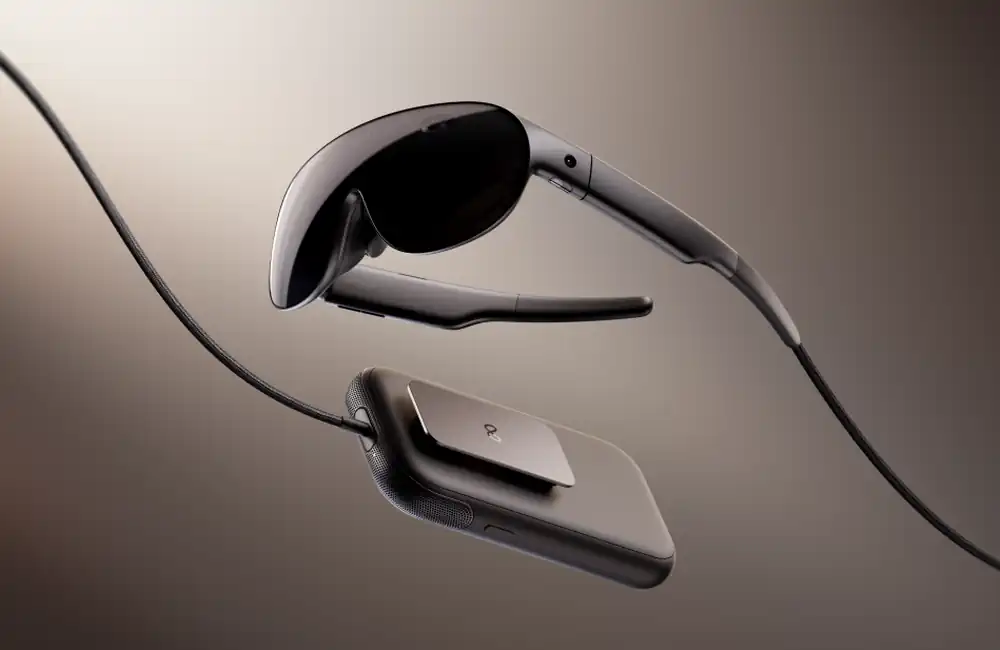
Meta says that the glasses are five times lighter than the Meta Quest 3 — and they look much more like normal eyewear than the bulky headsets the company has released before. The frames are made of magnesium alloy, and the glasses are powered by Qualcomm’s Snapdragon Reality Elite processor. They connect to a computing puck that doubles as a battery, which users can just slip into their pocket to use the glasses on the go.
The glasses are largely built for entertainment. Micro-OLED panels built into the lenses provide what Meta calls a 5K Infinite Display with 37 pixels per degree, along with Dolby Vision and Dolby Atmos audio support. Users will be able to download and watch movies.
Perhaps one of the more unique features of the glasses, however, is that Meta is pitching them as a great way to enjoy IMAX-captured films.
Indeed, the company calls the glasses the “first IMAX-enhanced certified VR device ever” and says they will be one of the few ways to experience the expanded aspect ratio that defines IMAX’s distinct high-resolution viewing experience.
The glasses also support 3D content, including movies that integrate a user’s physical space into their viewing experience. Meta says that it has teamed up with Disney and that in November, Disney+ users will be able to stream specific movies — including certain Marvel movies — in 3D.
Meta says that users will be able to watch specific movies and have their surroundings “transformed with immersive environments, dynamic effects, stunning 3D visuals, and spatial audio” — essentially converting the movie into a VR gaming-type experience.
The glasses will also come with Meta AI — its automated virtual assistant — built in, which means that users will be able to talk to the glasses and automate various tasks via voice command. For instance, Meta says you’ll be able to start a movie just by asking your glasses to do so. Other ways to issue commands include hand gestures.
Domain Pick:
1-vr.com — A Short, Numeric Entry Point to the VR Comeback
Meta’s new VR Glasses are a bet that virtual reality deserves another shot. At $1,299.99, five times lighter than the Quest 3, with a 5K Infinite Display, Dolby Vision and Atmos, and what Meta calls the “first IMAX-enhanced certified VR device ever,” the company is clearly trying to move VR from bulky headset to everyday eyewear.
Whether or not these glasses succeed, the announcement signals something bigger: VR is being repositioned as an entertainment-first, glasses-shaped category. That kind of reset often creates new demand for short, memorable domain names that can serve as a brand, a review site, a community hub, or a product landing page.
1-vr.com fits that space. It is extremely short, uses a single numeral and the two-letter VR abbreviation, and is instantly readable. The hyphen keeps it clean and separates the numeric prefix from the category term, which makes it feel more like a brandable label than a random keyword string. For a technology that has struggled with mainstream clarity, a name like this is easy to say, easy to type, and easy to remember.
It is not an exact-match domain like “vr.com” or “virtualreality.com” — those are either enterprise-priced or effectively unavailable. 1-vr.com is the practical alternative: a short, brandable, category-adjacent name that can be built into a media site, a review platform, a developer community, or a product brand around the next VR wave.
If Meta’s glasses help push VR back into the mainstream conversation, short category names like 1-vr.com become more valuable by association. This is a long-term narrative bet on VR’s second act, not a short-term flip.
Disclosure: This is an editorial domain recommendation, not investment advice. Domain values fluctuate with industry sentiment.
Source:https://techcrunch.com/2026/09/23/meta-is-trying-vr-glasses-again-this-time-with-more-imax/